
X-RAY RUNS: Apply for Beamtime
2017 Nov 1 - Dec 21
2018 Feb 7 - Apr 3
2018 Proposal/BTR deadline: 12/1/17
2018 Apr 11 - Jun 4
2018 Proposal/BTR deadline: 2/1/18
HIV's Crystal Key
Eddy Arnold, Center for Advanced Biotechnology and Medicine and Rutgers University Department of Chemistry and Chemical Biology, was recently featured in the Star-Ledger, December 12, 2004 for his crusading research in the pursuit of revolutionary AIDS drugs (DAPY compounds) which may be more effective treatments for HIV, the deadly virus that causes AIDS. Through Arnold's crystallography research and dedication to the concept that reverse transcriptase (RT) was a key target of HIV, the future now looks promising with one of the DAPY compounds (TMC-125) entering Phase III clinical trials in the near future. Arnold's group, which has used CHESS extensively to study RT, continues its efforts to detail the structure and function of RT, and to develop new classes of inhibitors that may be able to more effectively evade HIV drug resistance. They are also pursuing the development of an AIDS vaccine by generating combinatorial libraries of chimeric human rhinoviruses displaying key HIV neutralizing epitopes, including segments of the HIV-1 gp41, part of the highly conserved viral fusion machinery.
Complete article here (pdf)
To view Arnold's recent publications in the Journal of Medicinal Chemistry, click on the article below (these are links directly to the J. of Medicinal Chemistry and may require a subscription):
Roles of Conformational and Positional Adaptability in Structure-Based Design of TMC125-R165335 (Etravirine) and Related Non-nucleoside Reverse Transcriptase Inhibitors That Are Highly Potent and Effective against Wild-Type and Drug-Resistant HIV-1 Variants
online: 12/12/2004
_______________________________________________
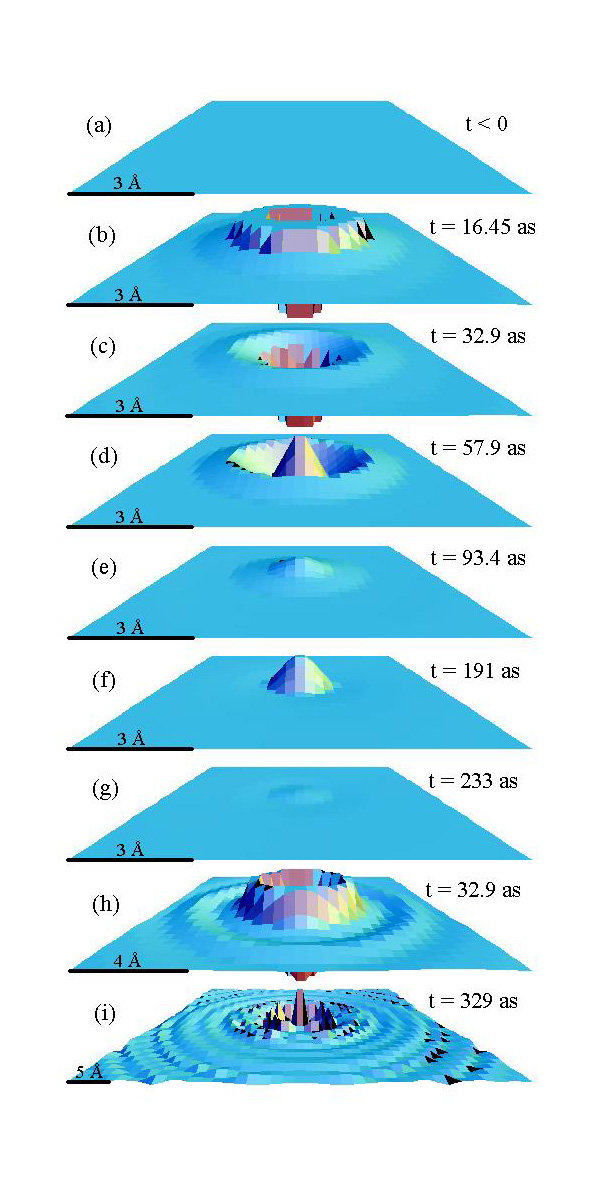
Imaging Density Disturbances in Water With a 41.3-attosecond Time Resolution
P. Abbamonte, K. D. Finkelstein, M. D. Collins, and S. M. Gruner
Phys. Rev. Lett. 92, 237401
(issue of 11 June 2004)
A research team has produced the fastest movies ever made of electron motion. Created by scattering x rays off of water, the movies show electrons sloshing in water molecules, and each frame lasts just 4 attoseconds (quintillionths of a second). The results, published in the 11 June PRL, could let researchers "watch" chemical reactions even faster than those viewable with today's "ultrafast" pulsed lasers.
also see:
pdf of article
APS - Physical Review 'Focus'
pdf
_______________________________________________